






NewsCenter
Wet Electrostatic Precipitator: Working Principle and Applications
Author: jiuzhoudust Date: 2026-10-18 10:17:08 Views: 198
Many industrial gas streams carry pollutants that defeat conventional collection equipment. Fine submicron dust, acid mists, and sticky or condensing aerosols resist capture by cyclones, baghouses, and even dry electrostatic precipitators because they either pass through the collection zone untouched or build up on dry surfaces until the equipment fouls. A wet electrostatic precipitator (WESP) is engineered for exactly these conditions. This article provides a complete overview of the technology: what it is, how it operates at a system level, how it compares with a dry ESP, where it is applied, and the factors that determine whether it is the right gas-cleaning choice for a given process.
What Is a Wet Electrostatic Precipitator?
A wet electrostatic precipitator is a particulate and mist control device that uses electrostatic forces to charge suspended particles in a gas stream and then collects them on surfaces that are kept continuously wetted by a liquid film. The core principle is the same as any electrostatic precipitator: an electric field charges particles, and that charge drives them onto a collecting surface. The defining difference is the wet surface.
In a dry ESP, accumulated dust forms a dry cake on the plates and is knocked off by mechanical rapping. In a WESP, the collected material is washed away continuously by irrigation water or another suitable liquid. That washing action is what makes the technology effective on wet, sticky, high-humidity, or high-resistivity aerosols that would blind, cake, or short out a dry collector. The result is a liquid waste stream rather than a dry dust stream, which is a central trade-off in selection.

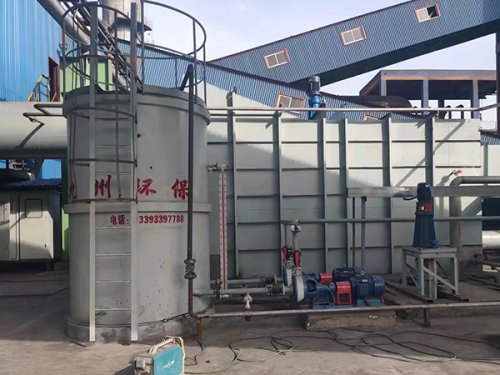
How a WESP Works (overview)
Corona discharge and particle charging
The WESP establishes a high-voltage field between discharge electrodes and a grounded collecting surface. The discharge electrodes emit a corona, a localized ionization of gas molecules in the high-field region, which generates a cloud of ions. As the contaminated gas passes through the field, suspended particles collide with those ions and acquire an electrical charge. In most industrial designs the discharge electrode is held at negative polarity, so particles become negatively charged and migrate toward the grounded collector.
Collection on wetted surfaces
Charged particles migrate under the influence of the electric field toward the collecting electrode. In a WESP the collecting surface is continuously irrigated, so particles arrive at a wetted wall, tube, or plate rather than a dry one. The liquid film captures them and holds them in place, which prevents the re-entrainment that can occur in dry units when a disturbed dust cake re-suspends back into the gas stream.
Continuous irrigation and sludge handling
Irrigation liquid flows over the collecting surfaces and carries the captured particulate and condensed material down to a sump or collection trough. The resulting slurry is then directed to downstream separation or treatment. Because rinsing is continuous rather than intermittent, the collection surface stays clean and maintains its performance even under loads that would rapidly foul a dry plate.
Major Components
Discharge electrodes
Discharge electrodes are typically wires, rigid bars, or frames hung along the centerline of cylindrical tubes or spaced between plates. They carry the high-voltage charge and must sustain a stable corona under the specific process gas conditions. Their alignment and cleanliness directly affect field uniformity and sparkover behavior.
Collecting electrodes / tubes
In many WESP designs the collecting surface takes the form of vertical tubes (tube-type WESP) or flat plates (plate-type WESP) that form the grounded collection wall. They are sized and arranged to provide the required residence time and field coverage for the target particle size distribution and gas volume.
Irrigation and rinse system
Distribution headers, nozzles, or overflow weirs maintain a uniform liquid film over the collecting surfaces. The system must avoid dry patches, which would compromise capture, while limiting excess liquid that would increase slurry volume and risk mist carryover into the outlet.
High-voltage power supply
A transformer-rectifier set converts plant power to the high direct current required for corona formation. Modern supplies include closed-loop control to hold the optimal voltage and to respond automatically to changes in gas condition, load, and sparkover tendency.
Housing and gas distribution
The shell encloses the electric field and manages the process gas. Inlet diffusers and flow-distribution devices promote even velocity across the field so that no lane is overloaded, bypassed, or short-circuited, which is essential for predictable collection efficiency.
Wet ESP vs Dry ESP: Key Differences
The fundamental distinction is the condition of the collection surface. A dry ESP collects on dry plates and removes accumulated dust by rapping; a WESP collects on wetted surfaces and removes material by continuous rinsing. That single difference cascades into several practical contrasts.
A WESP handles high-humidity, saturated, or condensing gas without the blinding that plagues dry units. It captures acid mists and sticky aerosols that would cake and foul dry plates, and it performs well on high-resistivity dusts that, in a dry ESP, can cause back-corona and a steep loss of efficiency. The trade-off is that a WESP produces a liquid waste stream that must be handled and treated, and its capital and operating profile reflects the irrigation and slurry systems that a dry unit does not require.
For plants deciding between the two, the deciding factors are usually gas saturation, particle stickiness, resistivity, and whether a liquid waste stream is acceptable. Where a dry ESP or baghouse can reliably handle the load, it is often preferred for lower water and wastewater burden. Where it cannot, the WESP fills the gap.
Industrial Applications
Acid mist and SO3 aerosols
Processes such as sulfuric acid concentration, phosphoric acid production, and certain flue-gas treatment steps emit fine acid mists and SO3 aerosols. A WESP captures these submicron mists that scrubbers and dry collectors routinely miss, protecting downstream equipment and meeting stack limits.
Submicron particulate from incineration
Waste-to-energy and hazardous-waste incinerators produce fine ash and condensable particulate that escape coarser collection stages. A WESP provides a final polishing stage capable of driving stack loading down to stringent limits where submicron fractions dominate.
Sticky or condensing fumes
Operations that generate tar, resin, or condensable organics produce fumes that adhere to and build up on dry surfaces. The irrigated collection surface in a WESP prevents that buildup and keeps the field effective, avoiding the progressive fouling that disables dry equipment.
Pulp and paper, chemical, power, and waste-to-energy
These industries rely on WESP where the gas is saturated, corrosive, or carries fine mist. In pulp and paper it controls tall-oil and sulfate mists; in the power sector it polishes flue gas after wet flue-gas desulfurization to remove residual particulate matter and SO3 mist; in chemical and waste-to-energy plants it handles condensing and corrosive aerosols at the tail of the treatment train.
Selection Factors
Whether a WESP is appropriate depends on a combination of process and site conditions. The gas condition, including temperature, humidity, and corrosivity, sets the material and irrigation requirements. Particle characteristics such as size distribution, resistivity, and stickiness determine whether wet collection is even necessary. Emission-limit severity, available footprint, and the plant's tolerance for a liquid waste stream and its treatment cost weigh on the economic case.
A WESP is frequently selected when a dry ESP or baghouse cannot reliably handle high moisture or sticky loads, or when a final polishing stage is needed below the capture range of upstream equipment. It is also a common choice where the gas is already saturated, such as immediately downstream of a wet scrubber or cooling tower, because introducing a dry collector into a saturated stream is rarely practical.
Operating and Maintenance Considerations
Because irrigation is continuous, water quality and distribution are central to performance. Suspended solids in the rinse water, scaling, or uneven flow can create dry patches and a measurable loss of efficiency. Discharge electrodes must stay centered and clean to hold a stable corona, and any mechanical shift or fouling should be corrected before it triggers sparkover.
The high-voltage equipment demands disciplined lockout/tagout procedures and routine insulation monitoring, since moisture and contaminants around insulators are a common cause of leakage and trips. Sludge handling must keep pace with collected load so that sump levels do not rise and flood the gas path. Routine attention to irrigation balance, sludge removal, and electrical condition keeps the unit operating within its design envelope.
FAQ
When is a WESP preferred over a dry ESP?
A WESP is generally preferred when the gas is saturated or condensing, when particles are sticky or high in resistivity, or when fine acid mist and submicron particulate must be captured that a dry unit or baghouse cannot hold reliably.
Can a WESP handle saturated or condensing gas?
Yes. A WESP is specifically suited to saturated, high-humidity, and condensing streams because the collection surface is wet by design, so condensation does not blind or foul it the way it would a dry collector.
What happens to the collected material?
The irrigation liquid carries captured particulate and condensed material to a sump as a slurry, which is then sent to downstream separation or treatment. The plant must plan for this liquid waste stream in the overall process design.
Does a WESP replace a scrubber?
Not usually. A WESP controls particulate and mist, while a scrubber removes gaseous pollutants. They are often placed in series, with the WESP polishing the gas after a wet scrubber where residual mist and fine particulate remain.
How is collection efficiency affected by particle size?
WESPs are especially effective on submicron fractions, which charge and migrate efficiently relative to their mass. Performance still depends on field length, voltage, and residence time, so design must match the actual particle size distribution.
Conclusion
The wet electrostatic precipitator occupies a distinct niche in industrial gas cleaning: it is the technology of choice for sticky, high-humidity, saturated, or submicron particulate and mist that defeats dry collection. Selecting the right unit means matching the gas condition, particle characteristics, and emission limits to the wet-collection approach, and planning for the irrigation and slurry systems that come with it. For engineers evaluating a tail-end polishing stage or a collector for a saturated, corrosive, or condensing stream, the WESP deserves serious consideration.
If you are scoping a wet electrostatic precipitator for a specific process stream, the engineering team at Jiuzhou can review your gas conditions and emission targets and help determine whether wet electrostatic precipitation is the appropriate technology. Learn more at jiuzhoudust.com.
References
U.S. Environmental Protection Agency. "Air Pollution Control Technology Fact Sheet: Electrostatic Precipitators." EPA-452/F-03-013.
U.S. Environmental Protection Agency. "Air Pollution Control Cost Manual," Section on Particulate Matter Controls (Electrostatic Precipitators). EPA/452/B-02-001.
Cooper, C.D. and Alley, F.C. Air Pollution Control: A Design Approach. Waveland Press.
Parker, K.R. Applied Electrostatic Precipitation. Springer.
White, H.J. Industrial Electrostatic Precipitation. Addison-Wesley.
 Recommended Products
 Contact Us
—— Consultation Hotline: +86 17331708686
—— WhatsApp:+8617331708686
—— Email: lujingya66@163.com
—— Website:https://www.jiuzhoudust.com
—— Address: Siying Development Zone, Botou City, Hebei Province, China