






NewsCenter
Catalytic Combustion: Working Principle and Industrial Applications
Author: jiuzhoudust Date: 2026-09-25 18:03:57 Views: 153
Industrial processes that emit volatile organic compounds (VOCs), hazardous air pollutants (HAPs), and odor-causing compounds face increasing regulatory pressure worldwide. Thermal oxidation has long been a standard abatement technology, but conventional thermal oxidizers require high operating temperatures — typically 760°C to 1,100°C — which translates to substantial fuel consumption and operating cost. Catalytic combustion offers a fundamentally different approach: achieving the same oxidation reactions at temperatures 300°C to 500°C lower through the use of a catalyst.
This temperature reduction is not a marginal improvement. It directly affects fuel cost, equipment sizing, material selection, and the economic viability of heat recovery. For processes with moderate VOC concentrations and continuous operation, catalytic combustion is often the most cost-effective abatement technology available. Understanding how it works, where it applies, and how to select the right system configuration is essential for engineers and environmental compliance managers responsible for air pollution control.
What Is Catalytic Combustion?
Catalytic combustion is an oxidation process in which a catalyst lowers the activation energy required to combust VOCs and other combustible gases. The VOC molecules adsorb onto the catalyst surface, where they react with oxygen at temperatures far below what would be needed for homogeneous (flame) combustion. The reaction products are the same as those from thermal oxidation: carbon dioxide, water vapor, and heat. The catalyst itself is not consumed in the reaction — it facilitates the oxidation without being permanently altered.
The key distinction from thermal oxidation is the role of the catalyst. In a thermal oxidizer, the gas stream must be heated to a temperature where the oxidation reaction proceeds spontaneously. In a catalytic oxidizer, the catalyst provides an alternative reaction pathway with a lower activation energy barrier, allowing the same conversion to occur at a significantly reduced temperature. This is the fundamental mechanism that delivers the fuel savings and operational advantages of catalytic combustion.
How Catalytic Combustion Works
Catalyst Role and Surface Chemistry
The catalyst in a catalytic oxidizer is typically a precious metal — platinum, palladium, or a combination of both — supported on a high-surface-area substrate. The substrate is usually a ceramic monolith with honeycomb channels, though bead or pellet catalyst beds are also used. The honeycomb structure maximizes the contact area between the gas stream and the active catalyst sites while maintaining a low pressure drop.
When VOC-laden gas passes through the catalyst bed, VOC molecules and oxygen molecules adsorb onto the catalyst surface. The catalyst weakens the bonds within the adsorbed molecules, lowering the energy barrier for the oxidation reaction. The reaction proceeds at the catalyst surface at temperatures where it would be kinetically negligible in the absence of the catalyst. The products — CO₂ and H₂O — desorb from the surface and exit with the gas stream.
The catalyst does not change the thermodynamics of the reaction. The same amount of heat is released regardless of whether the oxidation occurs thermally or catalytically. What the catalyst changes is the kinetics — the rate at which the reaction proceeds at a given temperature. This kinetic acceleration is what enables the lower operating temperature.
Temperature Requirements and Activation Energy Reduction
Conventional thermal oxidizers operate at temperatures of 760°C to 1,100°C to achieve destruction efficiencies of 90% to 90%. Catalytic oxidizers achieve comparable destruction efficiencies at temperatures of 260°C to 540°C, depending on the VOC species and the catalyst type. The temperature reduction is application-specific: some VOCs (like formaldehyde) oxidize readily at 260°C, while others (like benzene or methane) require higher temperatures approaching 400°C to 500°C.
The activation energy reduction is substantial. For example, the homogeneous oxidation of many hydrocarbons requires activation energies of 150 to 250 kJ/mol. On a platinum or palladium catalyst surface, the effective activation energy drops to 50 to 100 kJ/mol. This is why the reaction proceeds at temperatures several hundred degrees lower.
The operating temperature is selected based on the VOC species in the gas stream and the required destruction efficiency. If the gas stream contains a mix of VOCs, the temperature is set based on the most difficult-to-oxidize species. Operating below the required temperature results in incomplete destruction and potential formation of partial oxidation products, which can be more hazardous than the original VOCs.
Oxidation Reactions and Reaction Products
The basic oxidation reaction for a hydrocarbon VOC is: CₓHᵧ + (x + y/4) O₂ → x CO₂ + (y/2) H₂O + heat. For chlorinated VOCs, the reaction produces HCl in addition to CO₂ and H₂O, requiring downstream scrubbing to neutralize the acid gas. For sulfur-containing compounds, SO₂ is produced, with similar downstream treatment requirements.
The heat released by the oxidation reaction raises the gas temperature. For VOC-laden streams with sufficient concentration — typically above 3 to 5 g/m³ — the heat release can sustain the operating temperature without supplemental fuel, a condition known as self-sustaining operation. Below this concentration, supplemental fuel (natural gas or propane) is required to maintain the catalyst temperature.
The destruction and removal efficiency (DRE) is the primary performance metric. Most regulatory permits require a DRE of 90% or higher, with many applications requiring 90% to 90%. The DRE is verified through stack testing, measuring inlet and outlet VOC concentrations under representative operating conditions.
Types of Catalytic Combustion Systems
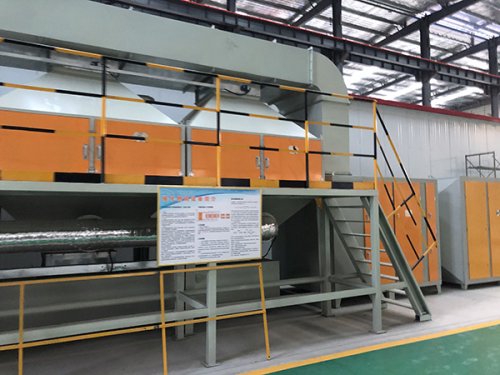
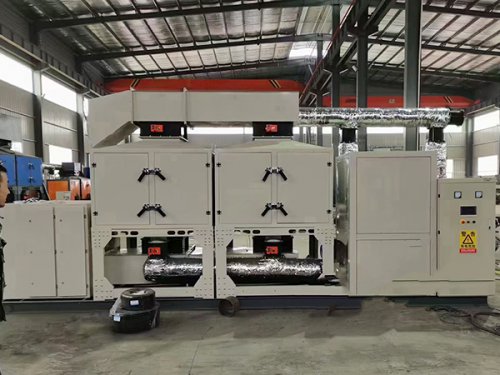
Recuperative Catalytic Oxidizers
A recuperative catalytic oxidizer (RCO) incorporates a primary shell-and-tube heat exchanger that transfers heat from the cleaned exhaust gas to the incoming dirty gas stream. This preheating reduces the amount of supplemental fuel required to bring the gas to catalyst operating temperature. Typical heat recovery efficiencies range from 50% to 70%.
The RCO is the simplest catalytic oxidation system. It is suited to applications with relatively stable VOC concentrations and moderate flow rates. The heat exchanger is a significant capital cost component, but the fuel savings typically justify the investment for continuous operation. The tube-side and shell-side materials must be selected for the gas stream composition — stainless steel is standard, with higher alloys for corrosive streams.
Regenerative Catalytic Oxiders
A regenerative catalytic oxidizer (RCO — sometimes distinguished as RCO-R for regenerative) uses ceramic heat recovery beds instead of a shell-and-tube exchanger. The gas stream passes through a ceramic bed that has been preheated from a previous cycle, absorbing heat and raising the gas temperature before it reaches the catalyst. After passing through the catalyst, the hot clean gas passes through a second ceramic bed, transferring its heat to the ceramic media. The flow direction reverses periodically, so each bed alternates between preheating and heat recovery modes.
This regenerative heat exchange achieves 90% to 90% thermal efficiency — significantly higher than recuperative designs. The result is that RCOs can operate with very low supplemental fuel consumption, even at VOC concentrations that would require substantial fuel in a recuperative system. The trade-off is higher capital cost, larger equipment footprint, and more complex valving and control systems.
RCOs are favored for large flow rates (above approximately 15,000 m³/h) and low to moderate VOC concentrations. They are widely deployed in chemical processing, coating operations, and printing facilities where flow rates are high and VOC concentrations are dilute.
Pre-mixed and Surface-Stabilized Combustion
A specialized form of catalytic combustion involves premixing the fuel and air before contact with the catalyst, with the combustion stabilized on the catalyst surface rather than in a flame. This approach achieves ultra-low NOx emissions because the reaction occurs at temperatures below the threshold where thermal NOx formation becomes significant. Surface-stabilized catalytic combustion is used in gas turbine applications and specialized industrial heating processes, though it is less common in VOC abatement than recuperative or regenerative systems.
Industrial Applications
VOC and HAP Destruction
The primary application of catalytic combustion is the destruction of VOCs and HAPs from industrial exhaust streams. EPA regulations under the Clean Air Act — including the Maximum Achievable Control Technology (MACT) standards — require many industrial sources to achieve specific VOC and HAP destruction efficiencies. Catalytic oxidizers are listed as an accepted control technology under numerous MACT standards, including those for surface coating, printing, pharmaceuticals, and chemical manufacturing.
The effectiveness of catalytic combustion for VOC destruction depends on the VOC species. Most hydrocarbon VOCs — including toluene, xylene, ethyl acetate, and MEK — are readily oxidized on precious metal catalysts at moderate temperatures. Some compounds, such as methane and ethane, are more difficult to oxidize catalytically and may require higher temperatures or a different catalyst formulation. Compounds containing silicon, phosphorus, or heavy metals can poison the catalyst and require pretreatment or alternative abatement approaches.
Printing and Coating Operations
Printing facilities — particularly rotogravure and flexographic printing — generate solvent-laden exhaust streams that are well-suited to catalytic oxidation. The solvents used (toluene, ethyl acetate, ethanol blends) are readily oxidizable, and the exhaust flow rates are moderate and relatively stable. Catalytic oxidizers in printing applications routinely achieve 90% to 90% DRE.
Coating operations, including automotive painting, coil coating, and can coating, also generate VOC-laden streams. In automotive paint shops, catalytic oxidizers are used on primer and topcoat flash-off zones, where solvent evaporation creates concentrated VOC exhaust. The steady flow and consistent VOC composition in these applications make them ideal for catalytic technology.
Chemical and Petrochemical Processing
Chemical plants and refineries generate vent streams containing a variety of organic compounds. Catalytic oxidizers are used on process vents, storage tank vent streams, and wastewater treatment plant emissions. The diversity of compounds in these streams — ranging from light hydrocarbons to heavy aromatics — requires careful catalyst selection and, in some cases, upstream conditioning (particulate removal, de-misting) to protect the catalyst.
In ethylene oxide and propylene oxide production, catalytic oxidizers destroy the low-concentration ethylene or propylene in the reactor vent stream. In phenol and acetone production, catalytic oxidation handles vent streams containing cumene and other intermediates. Each application requires a specific catalyst formulation and operating temperature tailored to the target compounds.
Odor Control in Food and Wastewater
Food processing facilities generate odor compounds — including aldehydes, ketones, amines, and sulfur compounds — from cooking, fermentation, and waste handling. Catalytic oxidation effectively destroys these compounds at moderate temperatures, and the lower operating temperature compared to thermal oxidation reduces the risk of creating nitrogen oxide byproducts from amine-containing streams.
Wastewater treatment plant odor control is another application. The odor from wastewater processes is primarily hydrogen sulfide and reduced sulfur compounds. While biofilters and chemical scrubbers handle many wastewater odor applications, catalytic oxidation is used when the exhaust stream also contains VOCs that require destruction in addition to odor removal.
Heat Recovery and Energy Efficiency
The heat generated by VOC oxidation can be recovered and used for process heating, further improving the overall economics of catalytic combustion. Secondary heat exchangers downstream of the catalyst extract additional heat from the clean exhaust, producing hot air, hot water, or thermal fluid for plant use. In self-sustaining operation — where VOC concentration provides sufficient heat without supplemental fuel — the system becomes a net energy producer, converting waste VOC into useful thermal energy.
This energy recovery capability is a significant advantage over alternative abatement technologies that consume energy without recovery potential. The economics improve as VOC concentration increases, making catalytic combustion particularly attractive for processes that generate moderate to high VOC loads.
Key Design and Selection Factors
Selecting a catalytic combustion system requires a thorough characterization of the gas stream. The critical design inputs are: flow rate (maximum, minimum, and average), VOC composition and concentration (including any spike conditions), oxygen content, temperature, moisture content, particulate loading, and the presence of catalyst poisons or inhibitors.
Catalyst poisons are compounds that deactivate the catalyst by bonding permanently to active sites or by physically coating the catalyst surface. Common poisons include silicon compounds (from siloxanes in sealants or mold release agents), phosphorus compounds, heavy metals (lead, mercury, zinc), and halogenated compounds at high concentrations. If poisons are present, upstream pretreatment — such as activated carbon adsorption or condensate removal — may be required to protect the catalyst.
Catalyst inhibitors are compounds that temporarily reduce catalyst activity without permanently damaging it. Sulfur compounds are the most common inhibitors; they reduce activity while present but the catalyst typically recovers when the sulfur is removed. The system designer must account for inhibitor effects by specifying a larger catalyst volume or higher operating temperature to maintain the required DRE during periods of inhibitor exposure.
Space velocity — the ratio of gas flow rate to catalyst volume — is a key sizing parameter. It determines how much contact time the gas has with the catalyst surface. Higher space velocities require less catalyst (lower cost) but achieve lower conversion. The optimal space velocity is determined through catalyst performance testing with the actual gas stream composition.
The heat exchanger selection (recuperative vs. regenerative) is driven by the flow rate and VOC concentration. For flow rates below approximately 5,000 m³/h with moderate VOC concentrations, a recuperative system is typically the most economical. For larger flows or very dilute streams, the superior heat recovery of a regenerative system justifies the higher capital cost.
Advantages and Limitations
The advantages of catalytic combustion are well-documented. The lower operating temperature reduces fuel consumption by 40% to 60% compared to thermal oxidation. The lower temperature also reduces NOx formation, as thermal NOx generation becomes significant only above approximately 1,000°C. Equipment materials can be specified for lower temperature service, reducing capital cost. The catalyst provides a stable, continuous destruction mechanism that does not require the temperature excursions associated with flame combustion.
However, catalytic combustion has limitations. The catalyst is susceptible to poisoning and fouling, which can lead to performance degradation and eventual replacement. Catalyst replacement is a significant cost — precious metal catalysts contain platinum or palladium, and the metal value alone can be substantial, though spent catalysts are typically returned to the supplier for metal reclamation and credit. The catalyst also imposes a pressure drop on the system, requiring fan power to overcome.
Catalytic combustion is not suitable for all VOC streams. Very high VOC concentrations — above approximately 25% of the lower explosive limit (LEL) — require dilution or alternative treatment to avoid overheating the catalyst. Streams with high particulate loading require upstream filtration to prevent catalyst fouling. And for some difficult-to-oxidize compounds, the temperature required for adequate destruction may approach that of thermal oxidation, eroding the fuel savings advantage.
Despite these limitations, catalytic combustion remains the technology of choice for a large segment of VOC abatement applications — particularly those with moderate flow rates, moderate VOC concentrations, and compounds that are amenable to catalytic oxidation. The combination of fuel efficiency, regulatory compliance capability, and potential for heat recovery makes it a compelling option when the application fits.
Frequently Asked Questions
What temperature does a catalytic oxidizer operate at compared to a thermal oxidizer?
Catalytic oxidizers typically operate between 260°C and 540°C, depending on the VOC species and required destruction efficiency. Thermal oxidizers operate between 760°C and 1,100°C. The 300°C to 500°C temperature reduction is the primary source of fuel savings in catalytic combustion, as less supplemental fuel is needed to bring the gas stream to operating temperature.
What compounds can poison a catalytic oxidizer catalyst?
Silicon compounds (siloxanes), phosphorus compounds, heavy metals (lead, mercury, zinc, tin), and high concentrations of halogenated compounds are the most common catalyst poisons. These substances bond to the active catalyst sites or form coatings that block VOC access. If poisons are present in the gas stream, upstream pretreatment — activated carbon adsorption, condensation, or particulate filtration — is required to protect the catalyst.
How long does a catalyst last in an industrial catalytic oxidizer?
Catalyst life depends on the application, gas stream cleanliness, and operating conditions. In clean applications with stable VOC streams and no poisons, a catalyst may last 5 to 8 years. In challenging applications with trace poisons or frequent thermal excursions, catalyst life may be 2 to 4 years. Monitoring outlet VOC concentration is the standard method for detecting catalyst deactivation — a rising outlet concentration indicates declining catalyst activity.
Can catalytic combustion handle chlorinated VOCs?
Yes, but with additional considerations. Chlorinated VOCs (such as dichloromethane, trichloroethylene, and chlorobenzene) can be oxidized catalytically, but the reaction produces HCl, which must be removed in a downstream scrubber. The catalyst formulation may need to be different from standard precious metal catalysts, as chlorine can accelerate catalyst deactivation. Specialized catalysts with modified support materials are available for chlorinated VOC applications.
When is a regenerative catalytic oxidizer (RCO) preferred over a recuperative catalytic oxidizer?
A regenerative system is preferred when the flow rate is large (typically above 15,000 m³/h) and the VOC concentration is low (typically below 3 to 5 g/m³). The regenerative heat exchanger achieves 90% to 90% heat recovery, allowing self-sustaining operation at lower VOC concentrations than a recuperative system. For smaller flow rates or higher concentrations, the simpler and less expensive recuperative design is usually more economical.
Conclusion
Catalytic combustion is a mature, proven technology for industrial VOC and HAP abatement. By lowering the activation energy for oxidation reactions, the catalyst enables effective destruction at temperatures far below those required by thermal oxidation — delivering fuel savings, reduced NOx emissions, and lower material costs. The technology is deployed across printing, coating, chemical processing, food, and wastewater applications, with system configurations ranging from simple recuperative designs to high-efficiency regenerative systems. Successful implementation depends on accurate gas stream characterization, proper catalyst selection, protection from poisons, and appropriate heat recovery strategy. When the application fits, catalytic combustion offers an unmatched combination of regulatory compliance and operating economy.
References
EPA, "OAQPS Control Cost Manual, Chapter 3.2: Catalytic Oxidizers," U.S. Environmental Protection Agency, Office of Air Quality Planning and Standards.
EPA, "Technical Bulletin: Catalytic Oxidizers," EPA Air Pollution Control Technology Series.
Spivey, J.J., "Complete Catalytic Oxidation of Volatile Organics," Industrial & Engineering Chemistry Research, American Chemical Society.
NFPA 86, "Standard for Ovens and Furnaces," National Fire Protection Association.
EPA, "National Emission Standards for Hazardous Air Pollutants (NESHAP)," Clean Air Act Section 112, U.S. Environmental Protection Agency.
 Recommended Products
 Contact Us
—— Consultation Hotline: +86 17331708686
—— WhatsApp:+8617331708686
—— Email: lujingya66@163.com
—— Website:https://www.jiuzhoudust.com
—— Address: Siying Development Zone, Botou City, Hebei Province, China